IN THIS ARTICLE

Reducing TRBOnet Database size

Incorrect email!

The article was successfully sent to the email

This article describes how to reduce TRBOnet database size to prevent upgrade failures and database corruption when using Microsoft SQL Server Express with a 10 GB database size limit.

When the database reaches the limit, new data cannot be written. During a TRBOnet upgrade, the database structure changes and size may increase by 20 to 30 percent.

If the database size is close to the limit at 8 to 10 GB, the upgrade may fail or cause database corruption.

Database Modes

Mode Description
MULTI_USER Default and normal operating mode for databases. There are no restrictions on the number of connections. Users can read/write and modify data
SINGLE_USER Transactions are rolled back. Database is available for administrative maintenance.
EMERGENCY Indicates possible corruption. Database may be in inconsistent state. Data recovery may not be possible.

Before new version install

1. Remove old or unnecessary data using TRBOnet Database maintenance tools.
2. Take a backup.
3. Proceed with the software and database upgrade.

Database upgrade attempt was unsuccessful due to database size limit

If a backup is available
1. Roll back to the previous version of the software.
2. Restore the database from the backup.
3. Remove old or unnecessary data using TRBOnet (see section "Appendix D: Backing up and Restoring Database and Audio Recordings" in the User Guide).
4. Create a final clean backup.
5. Proceed with the software and database upgrade.

If a backup is not available

Step 1: Check Database State

1. Open SQL Server Management Studio.
2. Verify that the database is in MULTI_USER mode.

Step 2: Stop TRBOnet Service

1. Stop the TRBOnet service before making database changes.
2. Keep the service stopped during maintenance to prevent new data from being written to the database.

Step 3: Identify Large Tables

Before making changes, check which tables use the most space.

USE {database_name};
GO
sp_msforeachtable N'EXEC sp_spaceused [?]';
GO

This script shows the size of each table, including related objects such as indexes.
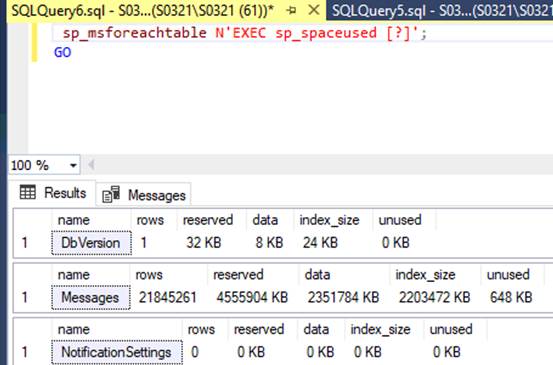
Tables index size

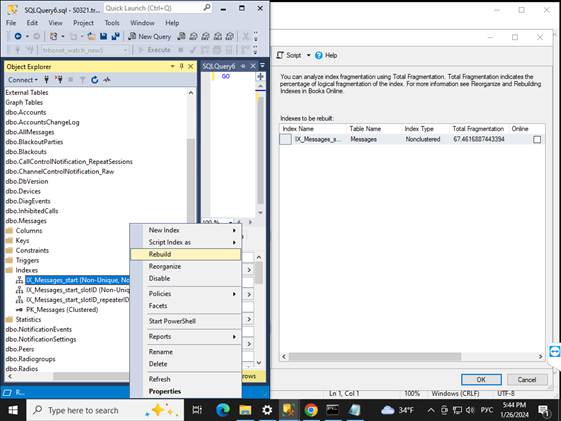
Step 4: Rebuild Indexes

1. Rebuild indexes where fragmentation is greater than 20%.
2. Focus first on the largest tables identified in Step 3.
Rebuild index dialog in SSMS

Step 5: Shrink the Database

After rebuilding indexes, SQL Server still reserves space based on previous data size.

To reclaim unused space, shrink the database:
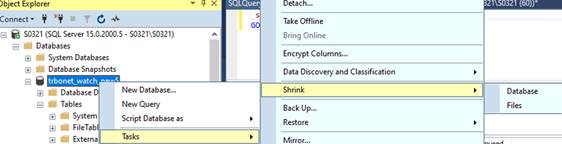
Shrink database option in SSMS

Step 6: Delete Old Data

Use procedure "sp_ClearOldData" with TRBOnet versions 5.7 and newer

Example for the table with GPS data [GpsInfo]:

DECLARE @return_value int

EXEC @return_value = [dbo].[sp_ClearOldData]
@tableName = N'GpsInfo',
@dateColumnName = N'date',
@date = '2022-11-07 00:00 +03:00'

The procedure deletes all records older than the specified date, starting from the oldest records. Make sure the date is correct before running the script.

Important Notes
Replace the example date with your own date.
TRBOnet uses datetimeoffset in the database.
Time is stored in UTC together with a time zone offset.
A time zone offset must be specified in the scripts when applicable.
In the example above, +03:00 represents a UTC+3 time zone.
To find out the datetimeoffset use SSMS → TRBOnet Database'Gps.Info' table → Select Top 1000 Rows'date' column.
Use DELETE command for TRBOnet versions before 5.7

Example for the table with GPS data [GpsInfo]:

DELETE FROM [TRBOnet].[dbo].[GpsInfo]
WHERE [date] < '2022-11-07 00:00'
Important Notes
Replace the example date with your own date.

Step 7: Shrink the Database

After deleting old data, perform another database shrink to reclaim the freed space.

1. Open the database context menu.
2. Select Tasks Shrink Database.

Step 8: Run Database Upgrade

Run the database upgrade after all maintenance steps are completed.

Expected Result

Database size is reduced below SQL Server Express limit.
Free space is available for database structure changes during upgrade.
Database remains in MULTI_USER mode.
No transition to SINGLE_USER or EMERGENCY mode occurs.
TRBOnet services operate normally after upgrade.
New data is written without errors.